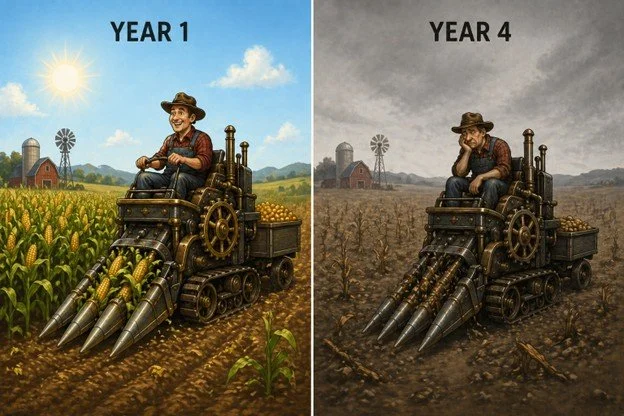
The Farmer with the Magic Harvester
A farmer once poured every dollar he had into building the most efficient corn harvester ever made. It was almost magic, picking each ear at exactly the right moment, faster than any of his neighbors could manage. To fund it, he stopped fertilizing his fields. He stopped sowing new seeds.
The first spring, he had a bumper crop and beat every farmer in the county. The second spring, his crop was a little smaller, but the harvester still won the day. By the third spring, he barely matched the previous year. By the fourth, his magnificent machine was scraping a meager harvest off thinning fields.
In nearly every marketing exec ed program we’re part of, the same question surfaces: brand marketing or performance marketing?
"Brand marketing" is upper-funnel work - growing awareness of your offering and building positive, persuasive associations. The idea is that when those folks enter the market for their next purchase in the category, you have an advantage. Think old-school TV, YouTube pre-roll, billboards, white papers, conference talks — things that reach people when they aren't actively looking. For farmers, this is fertilizing the fields and sowing new seeds.
"Performance marketing" focuses on people who are already in the market, usually based on data we have about them. Google search results, social ads, even ads served inside LLM results that are all aimed at a click and a conversion. For farmers, this is harvesting the ears that have already grown on their stalks.
People ask us, "Which one do we invest in?" Just to cut right to it: you need both, and figuring out the proper mix requires a commitment to test and learn. The shorthand we sometimes use is that one half generates demand and the other captures it.
Let's be honest. Performance ads have some pretty compelling benefits. They're easy to measure. Someone clicks or they don't. And that binary response means we can automate it. Google has been personalizing performance content in search ads since the mid-2010s, and now they (and others) offer solutions that automatically find the right people, figure out the optimal message, and use GenAI to generate a custom ad across the network. So — wow. A) I can measure it and show my boss how well it worked yesterday, B) I don't even have to pick targets, and C) maybe I don't even need to make the ads. Pretty compelling.*
Brand marketing, by contrast, is notoriously harder to measure and slower to pay off. There are testing services that'll tell you how a piece of creative performs against category norms and prior work. We can track brand health metrics: awareness, consideration, intent to buy, the positive and negative associations different groups have with the brand. But performance tells me sales, and brand tells me some metric that might lead to sales down the road. The uncertainty makes people uncomfortable.
Most folks intuitively get that you should be forming positive associations before a customer is in the buying phase. Once they're in market, people tend to stick with the brands they're familiar with and don't bother to stray without a compelling reason which is usually a lower price or a strong brand message.
So how do you justify brand marketing internally? One answer is a market test. Pick two markets, lean into upper-funnel work there, and track brand health metrics against control markets. You should expect the test markets to outperform over time. It might take a month. It might take a year. And while you're tracking brand metrics, track performance metrics too because when brand marketing works, performance metrics lift as well. Lower-funnel demand capture improves because more demand is being generated upstream.
The magic harvester is great if you only need to harvest one crop. If you want a farm that lasts, you have to seed and fertilize. When your team has doubts, pick a couple of fields and show them. Just make sure you give it the time to grow.
The incrementality of performance marketing is a story for another time. The short version: performance ads tend to work best on people who were going to buy anyway — meaning you didn't actually need to pay to reach them, and you're probably overestimating the tool's contribution.

Your Data is not your insight
Ask a brand team to share their consumer insights and you often get a deck full of facts. They tell you almost half their target consumers snack between meals. Millennials prefer experiences over products. Consumers are spending less in their category. These are facts. Some are interesting facts. None of them are insights.
This distinction matters more than most brands realize. You can build an entire marketing strategy on facts and still miss your consumer entirely — and when you miss your consumer, you risk limiting your ability to grow.
We define a consumer insight as a meaningful human truth. Every word is doing work.
Meaningful means it hasn't been fully articulated before. It doesn't have to be a volcano of new knowledge — sometimes it's simply naming something everyone has experienced but nobody has said out loud. When it lands, people don't say "I never knew that." They say "I've never heard it put that way, but yes — exactly."
Human means centered on lived experience. Not category logic or competitive positioning. What people actually feel, in real moments, in real life.
Truth means it holds up. People often recognize a real insight when they see it. They nod. It doesn't need explanation because it reflects something they already know to be true.
The Snickers campaign "You're Not You When You're Hungry" hits all three. The launch execution featured the late Betty White getting destroyed on a football field. The joke: the player wasn't really Betty White — it was a young man so off his game, so unlike himself, he may as well have been. Once he took a bite of Snickers he transformed from Betty White back to himself.
The insight wasn't about chocolate or snacking — it was about something universal: hunger changes your personality. You become irritable, irrational, a lesser version of yourself. Everyone has felt this. Nobody in the candy category had ever thought to name it.
Snickers didn't discover a new behavior. They articulated a human truth that was sitting there all along.
That campaign ran for years across dozens of executions worldwide. That is the power of a real insight — it becomes a platform, not just an ad.
Most brands don't fail because they lack data. They fail because they stop at the data. Ask yourself: is this a fact, or is it a meaningful human truth? The distance between those two things is the distance between a message that gets scrolled past and one that stops someone cold.

Growth Marketing: Know Where to Grow
Where do you grow? Casting a wide net sounds good, but frequently isn't as effective as identifying specific paths. The wide net can lead to broad, unfocused tactics while specificity can illuminate the exact right choices to drive growth.
The way goal-setting typically works in large companies often goes something like this: senior leaders agree on a target revenue number — X% growth over last year. That number gets divided among the teams below, who divide it further. As an illustrative example, a brand such as PepsiCo divides money until it reaches the Gatorade team; the Gatorade team is charged with generating $20 million in growth next year.*
The Gatorade team is likely to run a series of planning meetings that produce a series of initiatives: one on cost savings, one on distribution, one on a new flavor, one on advertising. Advertising is expected to account for $5 million of that growth. So everyone gets together and says, "Let's optimize — squeeze another $5 million out of roughly the same budget as last year." Everyone nods, because optimizing sounds smart. Then we end up doing roughly what we did last year, and luck determines all too much of the outcome.
One of the scariest — and most powerful — things we can do in goal-setting is commit to specificity. And we don't just mean "$5.6 million in net profit by December." We mean instead of following best practices and hoping for favorable outcomes, we identify the specific source of growth and design specific activities to achieve it.
It starts with knowing exactly which group of people you want to grow with. This isn't a critique of broad-reach masterbrand campaigns — it's about sharpening focus to deliver against a specific task. Generally, there are two groups to start with: people who already use your product, and people who don't. You want existing users to use you more, and new people to start. The next question is: why aren't they?
Behavioral psychologist and Nobel Prize-winning economist Daniel Kahneman framed it well: "Instead of asking how can I get him or her to do it, start with the question of why isn't she doing it already?" This forces us to identify the key impediment — the one barrier that, if we focused our efforts on it, we could overcome to drive growth.
Here's an example. We worked with a condiment company looking to grow in a flat category. They were one of two dominant competitors, with high loyalty, low switching, and already very high market penetration — most households had one of the two brands in the fridge. The only viable path to growth was through existing users. In research, we found that consumers had a limited view of how to use the product, which was constraining purchase frequency. (A finding we later encountered again, in both tequila and avocados.) When we got specific about what success would look like, we found that just one additional usage occasion per month across their existing base would translate to one more unit purchased annually — and $128 million in net sales. When you're trying to drive $5 million in growth, that kind of opportunity is hard to ignore. The resulting campaign, now in its tenth year, uses tactics across channels to expand consumers' ideas for how to use the product.
So when the CEO asks, "Why are we doing X?" the answer shouldn't be "best practices." It shouldn't be "because consumers said flavor was important." It should be: our most attractive path to growth was through existing users, whose purchase behavior was constrained by limited awareness of use cases — so we targeted that impediment directly.
Want to pursue a different path to growth? Go for it, if you have the resources. Just treat it as a separate initiative, with tactics driven by its own specific audience and barrier. The best tactics for one growth path are rarely the best tactics for another.
*We reference Gatorade as an example for concreteness. We have not asked the Gatorade team how they do it, but the train of thought tracks brands we have worked for or interacted with.

Duncker's Candle: Are You Solving the Right Problem?
In 1945, the psychologist Karl Duncker gave participants a wax candle, a box of thumbtacks, and a book of matches. Their task: affix the candle to the wall. Only about 25% found the optimal solution.
Duncker reports that most people tried to melt the wax and stick the candle directly to the wall, or contort the tacks into some kind of support. They were solving the problem — just not very well. Then Duncker made one small change. He presented the same materials, but with the tacks placed outside the box. Almost everyone solved it immediately. They tacked the box to the wall and set the candle inside it.
Same materials. Completely different outcome.
When the tacks were inside the box, people saw the box as a container. The moment the tacks were separated, the box became something else — a shelf, a platform, a solution. Duncker called this phenomenon functional fixedness: the tendency to see an object only in terms of its conventional use, even when a better use is sitting right in front of you.
Most people nod at this story and think about product design or innovation. We think about marketing.
Take cheese. When marketers think about differentiating a cheese brand, they tend to reach for the same set of levers — flavor, texture, variety, quality, price. Those are the tacks in the box. Everyone in the category is working from the same list, optimizing against the same attributes, watching the same competitors. The result is a category full of brands solving the same problem in slightly different ways.
Kellogg alum Ann Legan faced exactly this situation with Babybel in the United States. Rather than compete on the familiar category attributes, she looked at something the category had largely ignored: the usage occasion. She repositioned Babybel not as a cheese but as a healthy snack — a portable, portion-controlled product that offered indulgence without the guilt. She took the tacks out of the packaging, so to speak, and suddenly people saw new usage occasions.
The brand grew significantly. Not because the product changed, but because the problem being solved changed.
This is what competitor obsession can cost you. When you spend most of your energy watching what everyone else in your category is doing, you inherit their blind spots along with their playbook. You risk getting better and better at solving the wrong problem. The brands that break through tend to be the ones that stepped back and asked a different question — not "how do we win on the attributes everyone is competing on?" but "what problem are we actually in a position to solve for our customers that nobody else is solving?"
Next time you sit down to plan your marketing, remember Duncker's candle. The materials you need may already be on the table. The question is whether you can see them for what they are.
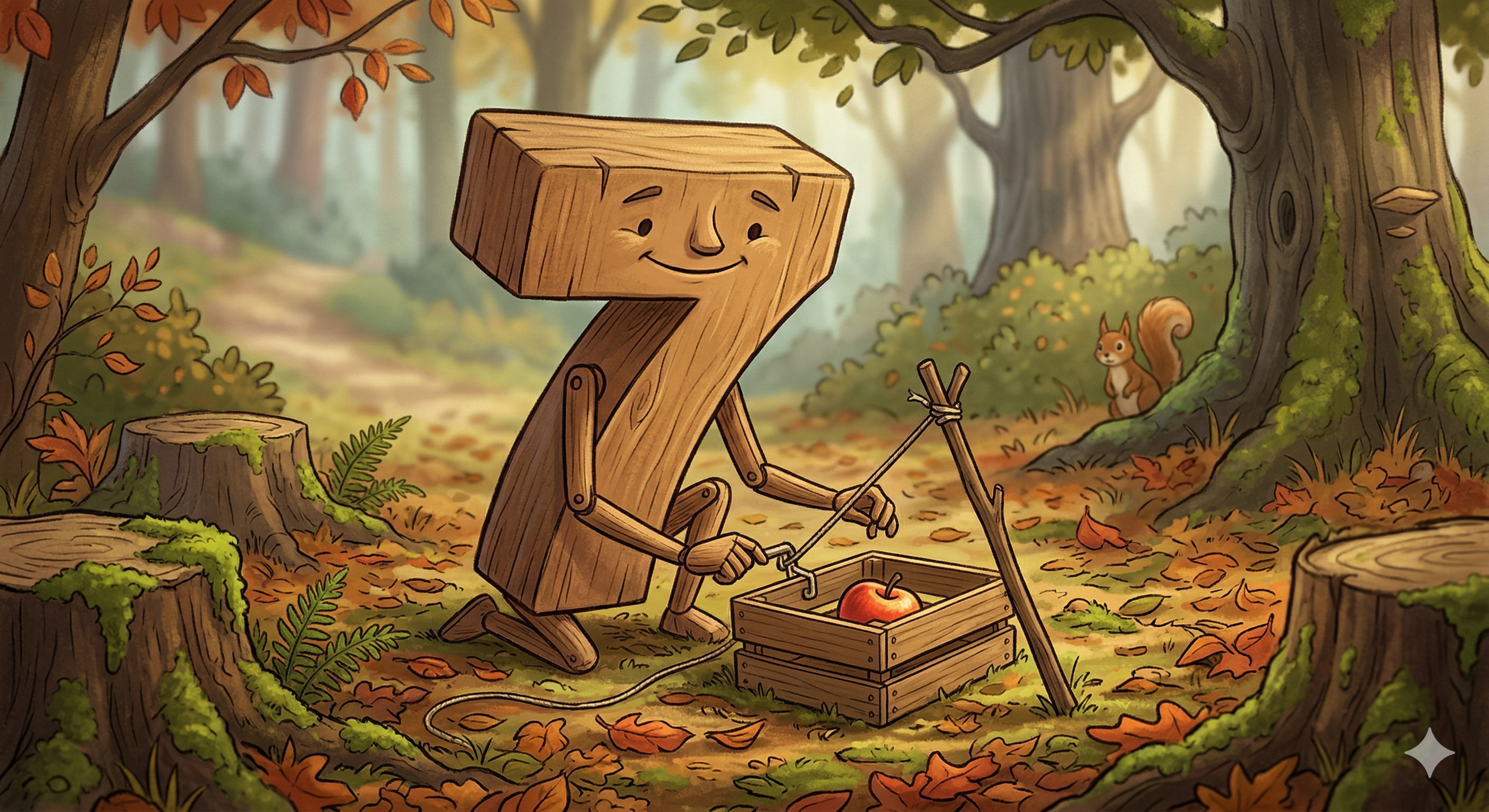
Growth Marketing: The Trap of the 7
The Trap of The Seven
"The essence of strategy is choosing what not to do." Michael Porter wrote that thirty years ago in HBR. Most marketers nod when they hear it. Very few act on it. Here's why it matters right now. The modern marketing landscape has never been more accessible — you can build a product, create your own ads, sell through your own site or a dozen marketplaces, and have AI handle much of the execution. We observe what seems to be a conditioned response by marketers—do more. More channels, more features, more markets. More is more. Growth is more.
We want to push back on that. What we consistently find is that the firms who grow most effectively are the ones who deliberately limit themselves. Most brands fall into what we call the Trap of the 7. Given limited resources — and every firm has limited resources, including behemoths like Amazon and Google — companies end up spreading investment across a long list of attributes: price, quality, service, experience, design, security. The goal, consciously or not, becomes getting everything up to a 7 out of 10. Competent across the board. Not great at anything.
Here's the problem. Not all attributes matter equally to all customers. Some customers want a 10 on service and will happily accept a 4 on price. A 7 on price and a 7 on service doesn't give them what they actually want. You've spent the resources and still lost the sale. There's a harder truth underneath this. Think of your behavior as a consumer. You likely drive past 7's. You scroll right by them. Think of a brand that's fine — reliable, inoffensive, solid. You probably just thought of one. Now think about the last time you chose it over something else because you had to have it. That's the trap. Meanwhile, some competitor has figured out the exact combination a specific customer segment wants. A slightly expensive energy drink — a 4 on price — but a 10 on clean ingredients and protein. It finds its people and it wins with them. Their 4 on price isn't a weakness. It's a trade-off they made on purpose. The question isn't how to get everything to a 7. It's: where do we want to be a 10, and what can we accept as a 5?
The resistance we hear most often sounds like this: "But on average, customers want a 7 on this attribute." Maybe. But averages mask the segments that will actually drive your growth. Competing for the average is a race to the middle — and someone will always be willing to run it cheaper than you. Why not just be 10's on everything? Nothing is. A firm that prioritizes quality of materials cannot compete as well on price. A firm that develops a technically complex product cannot readily claim simplicity.
So what do we do? We focus. We choose what not to do. We ask: how can we be a better choice for some customers than the competition? What are we uniquely good at that we can push further? Who are the customers most likely to value exactly that? Those answers drive everything — R&D, targeting, messaging, pricing, distribution. We give the same advice to our students. Don't spend your time at Kellogg turning your 5's into 7's. You'll burn time getting to average when you could be turning an 8 into a 10.
The same is true for your brand.
Learn more about our Executive Education program on Growth Marketing here: kell.gg/lgrowth